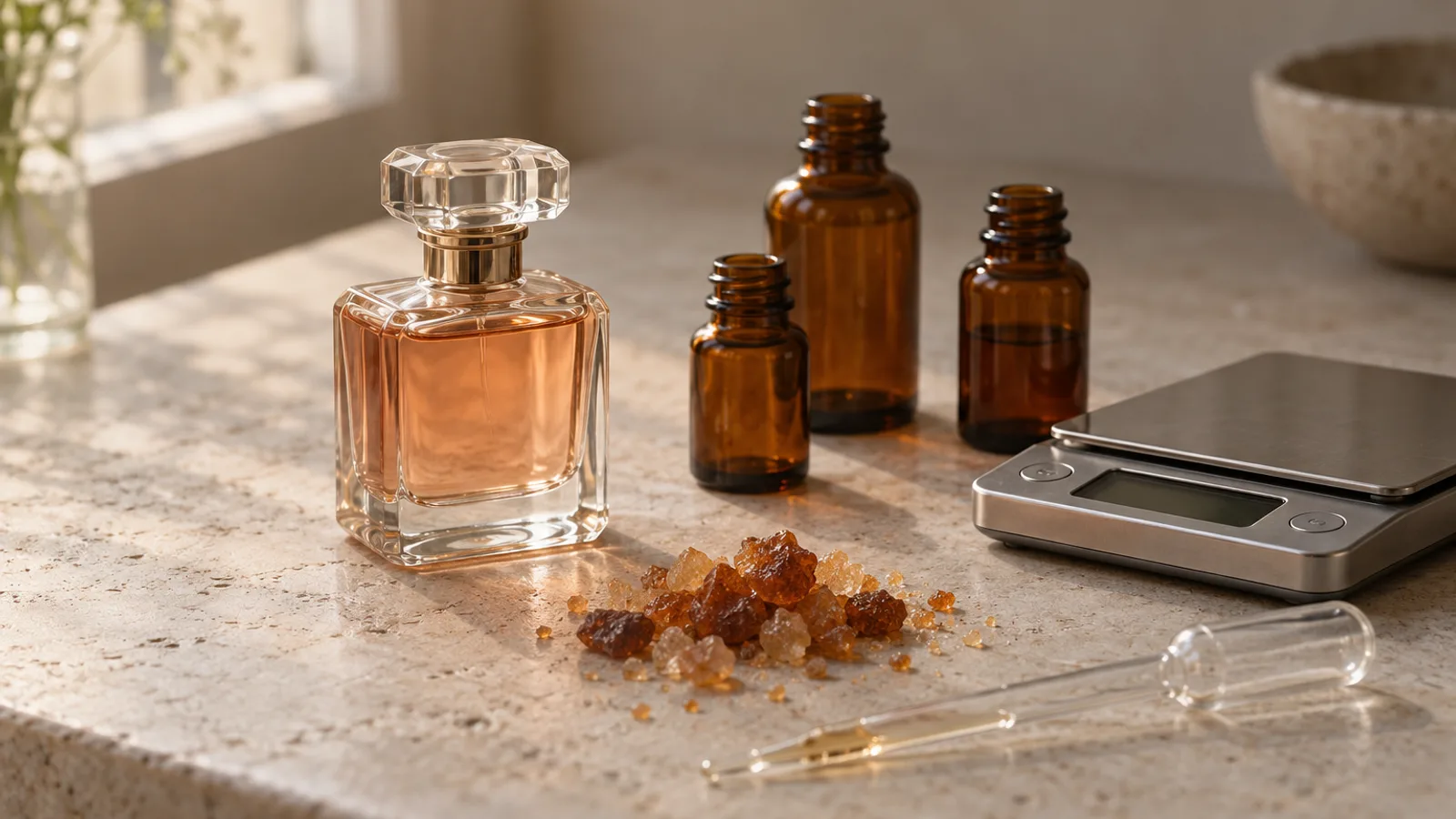
Short answer: you can make a convincing Baccarat Rouge 540 dupe at home with sixteen materials, and three of them do most of the work: Hedione, Ambroxan and Veramoss, an oakmoss molecule. A spoonful of ethyl maltol adds the burnt-sugar sweetness everyone recognises. For a 70 ml bottle the materials cost a few euros. The full formula with every dose is free on our formula page.
You have smelled it even if you have never worn it. It hangs in hotel lifts and in the air behind strangers on the street: sweet, airy, a little salty, like candy floss held next to warm skin. It came out in 2015 and became the most copied perfume of the decade, which tells you something useful before you start. A scent that dozens of brands have cloned is a scent with a simple skeleton.
What Baccarat Rouge 540 is made of
We rebuilt the formula from gas chromatography and checked it against the finished perfume. Leave out the solvent and the picture looks like this:
| Material | Share of the formula | What it does |
|---|---|---|
| Hedione | about a third | Transparent jasmine. It gives the scent its air and lift. |
| Ambroxan | about a fifth | Dry, mineral amber. The skin-like glow that lasts for hours. |
| Veramoss | about an eighth | Oakmoss without the forest floor. The faintly salty, inky depth. |
| Ethyl Maltol | about 2% | Burnt sugar and candy floss. |
| Paradise Molecule | about 2% | A brighter, more radiant cousin of Hedione. |
| Methyl jasmonate, orange, neroli, jasmine, saffron notes | under 1% each | Small touches that keep it from smelling like a lab sample. |
Hedione, Ambroxan and Veramoss together make up roughly two thirds of the formula. That is why so many cheap versions get close: buy those three and you already have the outline. The difference between a close dupe and a good one sits in the remaining third, the fractions of a percent that most clones skip.
Why it smells sweet without vanilla
Most people describe Baccarat Rouge 540 as sugary, and expect vanilla in the list. There is none. The sweetness comes from ethyl maltol, the molecule that makes candy floss and caramel smell the way they do, used at only about 2%. Ambroxan and Veramoss then pull that sugar sideways into something dry and mineral. Remove the ethyl maltol and you get a clean, almost cold amber. Double it and the perfume turns into a dessert. If your homemade version smells like a sweet shop, check that dose first.
Making a 70 ml bottle
Get the materials
You need the three main materials in quantity and the rest in tiny amounts. Hedione and Ambroxan are sold by every hobby supplier. Veramoss sometimes appears as Evernyl, the same molecule under another maker's name. Buy the small traces as ready-made dilutions if you can, since weighing 0.02 g of a pure material is harder than it sounds.
Work out the weights
The original is an eau de parfum, which means the concentrate sits around 18 to 20% of the bottle. For 70 ml at 18% you need about 12.6 g of concentrate. Each material's weight is its share of the formula times 12.6, divided by 100. Our free formula calculator does this for any bottle size and accounts for dilutions.
Weigh, mix, add alcohol
Use a scale that reads 0.01 g. Weigh the small materials first, the big three last, so a slip on Hedione does not ruin a measured trace. Ambroxan comes as a powder: let it dissolve in the Hedione before you add the alcohol. Top up with perfumer's alcohol to 70 ml.
Wait
Leave the bottle in a dark cupboard for two to four weeks and shake it now and then. On day one the ethyl maltol sits on top and the blend smells thin. By week three the materials have settled into each other and the sugar reads as part of the amber instead of next to it.
What it costs
At retail prices from a hobby supplier, the materials for one 70 ml bottle at 18% come to around 7 dollars. The first order costs more because you buy each material in a full bottle, but those bottles last for dozens of batches. A 70 ml bottle of the original sells for about 300.
That gap explains why this perfume became the first one many people try to make. It also explains the flood of ready-made dupes. Making your own takes an afternoon and a scale, and you can adjust it: less ethyl maltol if you find the original too sweet, a touch more Ambroxan if you want it to last longer on skin.
Close, but not identical
A homemade version can get very close, but some differences will remain. The original uses its own grades of materials, and the trace notes change with every batch the house makes. A good dupe smells like the same perfume to most noses. Side by side on two blotters, a trained nose will still find the seam, and that is fine. You are making a perfume you like for a fraction of the price, and you know what is in it.
Common questions
What are the main ingredients in Baccarat Rouge 540?
Hedione, Ambroxan and Veramoss make up about two thirds of the formula, with ethyl maltol giving the burnt-sugar sweetness. About a dozen smaller materials complete it, each under 1%.
Is it legal to make a Baccarat Rouge 540 dupe?
Making a perfume that smells similar is legal in most countries, for yourself or for sale, as long as you do not use the original's name, bottle or logo on the product. We cover the court cases in are perfume dupes legal.
How long does a homemade Baccarat Rouge 540 need to macerate?
Two weeks at least, four if you can wait. The ethyl maltol and the Ambroxan take the longest to blend into the rest.
Why does my dupe smell different on my skin?
Ambroxan is one of the materials some people barely smell, and it reacts to skin temperature. If the scent seems to vanish on you but others notice it, the Ambroxan is doing its job.