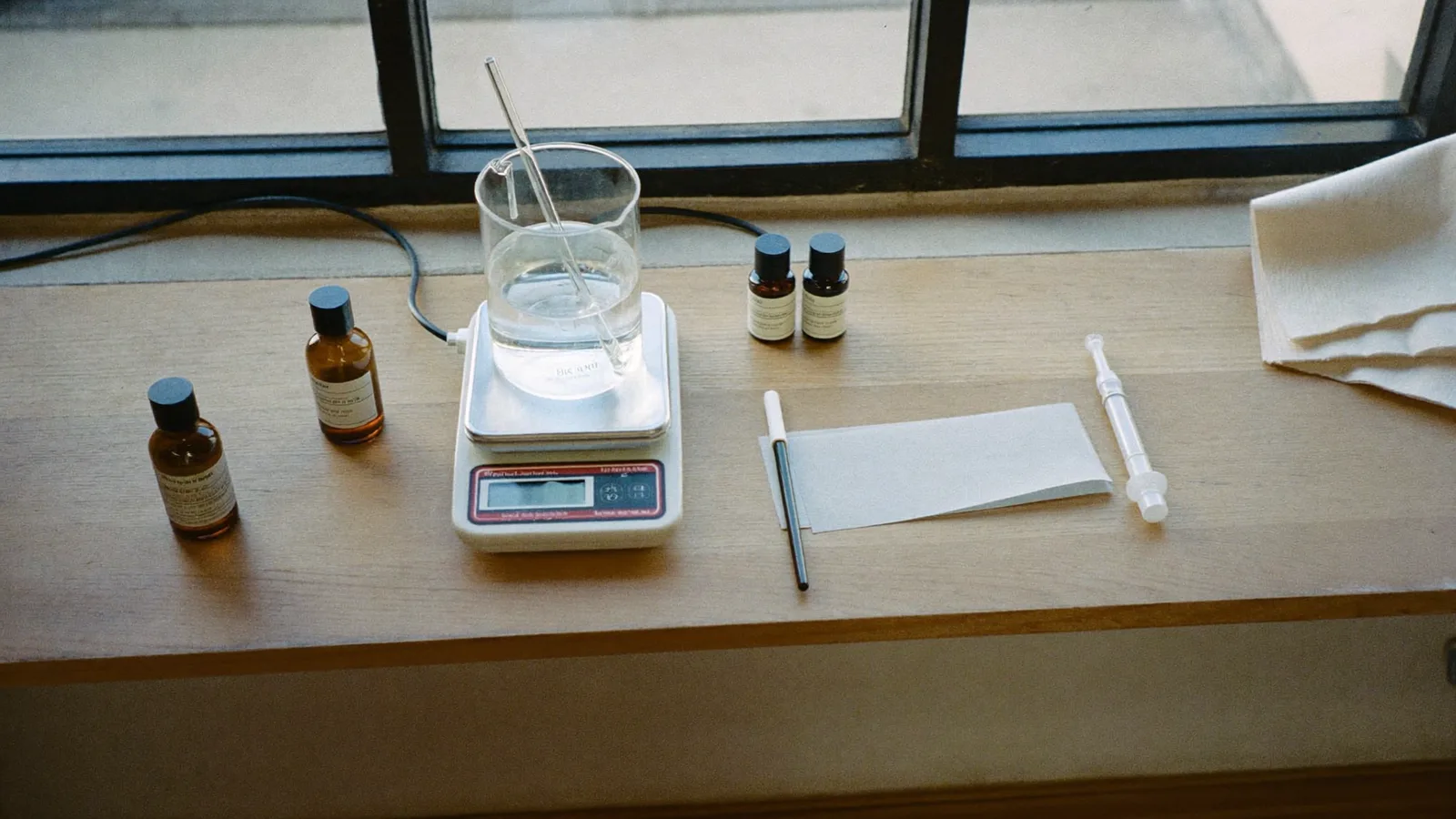
Making a perfume is weighing. That sounds reductive, and it is the single most useful thing anyone told me when I started. A formula is a list of materials with a number next to each one. You put a beaker on a scale, you add the numbers, you let it rest, you dilute it, and you wait again. The creative part happens before and after that, never during.
The reason most first attempts smell like a candle shop is not bad taste. It is dosing. People pour, and the materials that matter in a perfume work at fractions of a percent.
What is actually in a commercial perfume
We hold 768 reconstructed formulas of well-known fragrances, and we can count what turns up in them. The answer surprises people who expect long lists of rare naturals.
| Material | Appears in | Typical dose | Range seen |
|---|---|---|---|
| Hedione | 719 of 768 formulas | 10.9% | 0.01 – 60% |
| Iso E Super | 693 | 16.9% | 0.01 – 62% |
| Ambroxan | 693 | 3.3% | 0.01 – 29% |
| Coumarin | 557 | 1.0% | 0.01 – 7.9% |
| Citronellol | 533 | 1.0% | 0.01 – 56% |
| Geraniol | 527 | 0.6% | 0.01 – 12% |
| Vanillin | 518 | 1.4% | 0.01 – 14% |
| Ethylene Brassylate | 501 | 6.5% | 0.03 – 44% |
| Florol | 488 | 2.8% | 0.01 – 30% |
| Linalool | 462 | 2.6% | 0.01 – 25% |
Three materials appear in roughly nine of every ten formulas. Hedione, Iso E Super and Ambroxan are not top notes you would recognise by name; they are the structure everything else sits on. Hedione makes a composition feel airy and lifted, Iso E Super gives it a woody spine that carries for hours, Ambroxan does the warm skin-like part underneath. Buy those three first. You can build a recognisable perfume with eight materials if three of them are these.
Note the ranges. Citronellol shows up anywhere from a trace to 56% of a composition. A material has no correct dose in the abstract, only a correct dose in a formula.
The kit, honestly costed
A scale reading to 0.01 g is the one thing you cannot substitute. Everything else has a cheap version that works.
- Scale, 0.01 g resolution. Around 20 to 30 euro. Below that resolution you cannot weigh a 0.05 g material, and half the palette is used at that level.
- Perfumer's alcohol. Denatured ethanol at 96%. A litre lasts a long time.
- Glass beakers and pipettes. Plastic picks up smell and passes it to the next batch.
- Blotters. Paper strips. You will use hundreds.
- The materials themselves. This is where the money goes.
A starting palette of ten materials costs somewhere between 60 and 120 euro depending on supplier and size, and it makes a great many bottles. The marginal cost of a 30 ml bottle after that is usually under 3 euro of raw material. That is the arithmetic that makes this worth doing.
Where to buy materials
Not from a perfume shop. You want suppliers who sell to perfumers: Pell Wall in the United Kingdom, Hekserij in the Netherlands, Fraterworks and Perfumer's Apprentice in the United States all ship small quantities to hobbyists. Order by CAS number rather than by name where you can, because the same molecule travels under several trade names and the CAS is unambiguous.
Making a 30 ml bottle, start to finish
Choose a formula and read it before you touch anything
A formula is written in parts per 100. Check which materials you have, which you need to order, and which are listed at a dilution rather than neat. That last one catches everyone: a line reading "Galaxolide 50%" means fifty parts of a half-strength solution, not fifty parts of the material.
Convert parts into grams
Decide the aromatic load first. An eau de parfum is typically 15 to 20% concentrate in alcohol, an extrait 20 to 30%. For 30 ml at 18%, you need about 5.4 g of concentrate, and each material's weight is its part number times 5.4, divided by 100. A calculator does this in a second and removes the most common source of error.
Dilute anything you cannot weigh accurately
If a material lands below about 0.05 g on your scale, weigh a 10% or 1% solution of it in alcohol instead, at ten or a hundred times the weight. This is not a shortcut, it is how professionals work, and it is why every serious formula specifies dilutions.
Weigh the concentrate
Tare the beaker, add one material, note the actual weight, tare again. Work from the largest quantity down so a slip on a small material can still be corrected. Write down what you actually weighed, not what you meant to weigh.
Let the concentrate rest before you dilute it
This step gets skipped in almost every beginner guide, and it is the one professionals never skip. Seal the finished concentrate, undiluted, and leave it in the dark for a few days to two weeks. The materials react with each other at this concentration in a way they cannot once they are swimming in alcohol. Heavy compositions with resins, vanillin or animalics gain the most. This is maturation.
Dilute in alcohol, with a little water
Now bring it up to volume. Perfumer's alcohol is the carrier, and commercial production adds a small amount of demineralised water with it, usually a few percent. Water is not a filler: it changes the solubility of the composition and softens the alcoholic bite of the opening. Start with 3 to 5% of the total and leave the rest to alcohol.
Macerate: sealed, dark, still
Close the bottle and leave it alone. This is maceration, and it is where the diluted composition stops being a list of materials and starts being a perfume. Two weeks is the working minimum for a light citrus or aromatic. Six weeks or more is normal for oud, resins and heavy orientals, and factories hold these for exactly that reason. Dark, room temperature, no shaking. A blend judged on day one smells sharp and disjointed, which is how most people conclude they cannot do this.
Chill and filter, if you want it clear
Optional at home, standard in production. Cool the macerated perfume to around minus five to minus ten degrees for a day, then pass it through a coffee filter or a laboratory filter paper while still cold. Waxes from naturals, resin fragments and anything else that came out of solution stay behind. The French call the step glaçage. It changes nothing about the smell and everything about whether the bottle looks like a finished product.
The two mistakes that waste the most money
Buying broadly instead of deeply. Thirty materials you barely know produce worse results than eight you understand. Smell each new material on a blotter, neat and diluted, over three days before you put it in anything.
Not writing it down. Every batch gets a number, a date and the exact weights. The blend you love and cannot reproduce is the most demoralising thing in this hobby, and it happens to everyone who trusts their memory once.
Common questions
Can you make perfume without alcohol?
Yes. The same concentrate can go into a carrier oil such as fractionated coconut or jojoba, usually at 15 to 25%. Oil-based perfume sits closer to the skin and projects less, and it does not go through the sharp alcoholic opening. Solid perfume in beeswax works the same way.
What is the difference between maturation and maceration?
Maturation is the concentrate resting on its own, before any alcohol: days to two weeks, and it is where materials at full strength react with each other. Maceration is the diluted perfume resting after the alcohol goes in: two weeks for something light, six or more for oud and resins. The words are used interchangeably in a lot of writing, including by brands, but in production they are two separate holds and the concentrate one comes first.
How long does perfume need to macerate?
Two weeks is the working minimum for a citrus or a light aromatic, four is better, and heavy compositions with resins, vanillin or oud keep improving for a couple of months. Factories hold oud and orientals for six weeks or more for exactly this reason. Dark, room temperature, sealed. Refrigeration is unnecessary during maceration and shaking it daily does nothing.
Should I add water to my perfume?
A few percent, yes. Commercial production dilutes with high-proof ethanol plus a small amount of demineralised water, typically low single digits. It changes the solubility of the composition and takes the sharp edge off the alcoholic opening. Use demineralised or distilled water, never tap, and add it with the alcohol rather than afterwards.
Why is my perfume cloudy?
Waxes and resin fragments that came out of solution, almost always from naturals. Chill the bottle to around minus five to minus ten for a day and filter it cold through a coffee filter. Production calls this glaçage and does it to every batch. It removes nothing you can smell.
How many ingredients does a perfume need?
Across the 768 formulas we hold, the median is around 45 materials, and the simplest sit near 20. A beginner can make something genuinely good with 8 to 12. Commercial formulas are long because they solve problems of stability, cost and regulation as well as smell.
Why does my perfume disappear after an hour?
Almost always missing base. Top notes evaporate in minutes by design. If a composition has no musks, woods or amber materials underneath, there is nothing left to smell. Ethylene Brassylate, Iso E Super and Ambroxan are the usual fix, and our data shows them in more than 500 of 768 commercial formulas each.
Is it legal to recreate a commercial perfume?
Formulas are not protected by copyright in the European Union or the United States; brand names and packaging are. You can make and wear a composition inspired by any fragrance you like. Selling it under that fragrance's name is a different matter entirely.
Do I need to worry about IFRA limits?
For a bottle you wear yourself, no. IFRA standards govern what companies may put on the market. If you ever sell, they become binding and you will also need a safety assessment. Common sense still applies at home: some materials sensitise skin, and a few should never be used neat.
Where to go next
Pick a fragrance you already know well and work from its formula rather than inventing from nothing. You will learn more in one afternoon rebuilding something familiar, because your nose already knows the target, than in a month of guessing. Five complete formulas on this site are free, doses included.