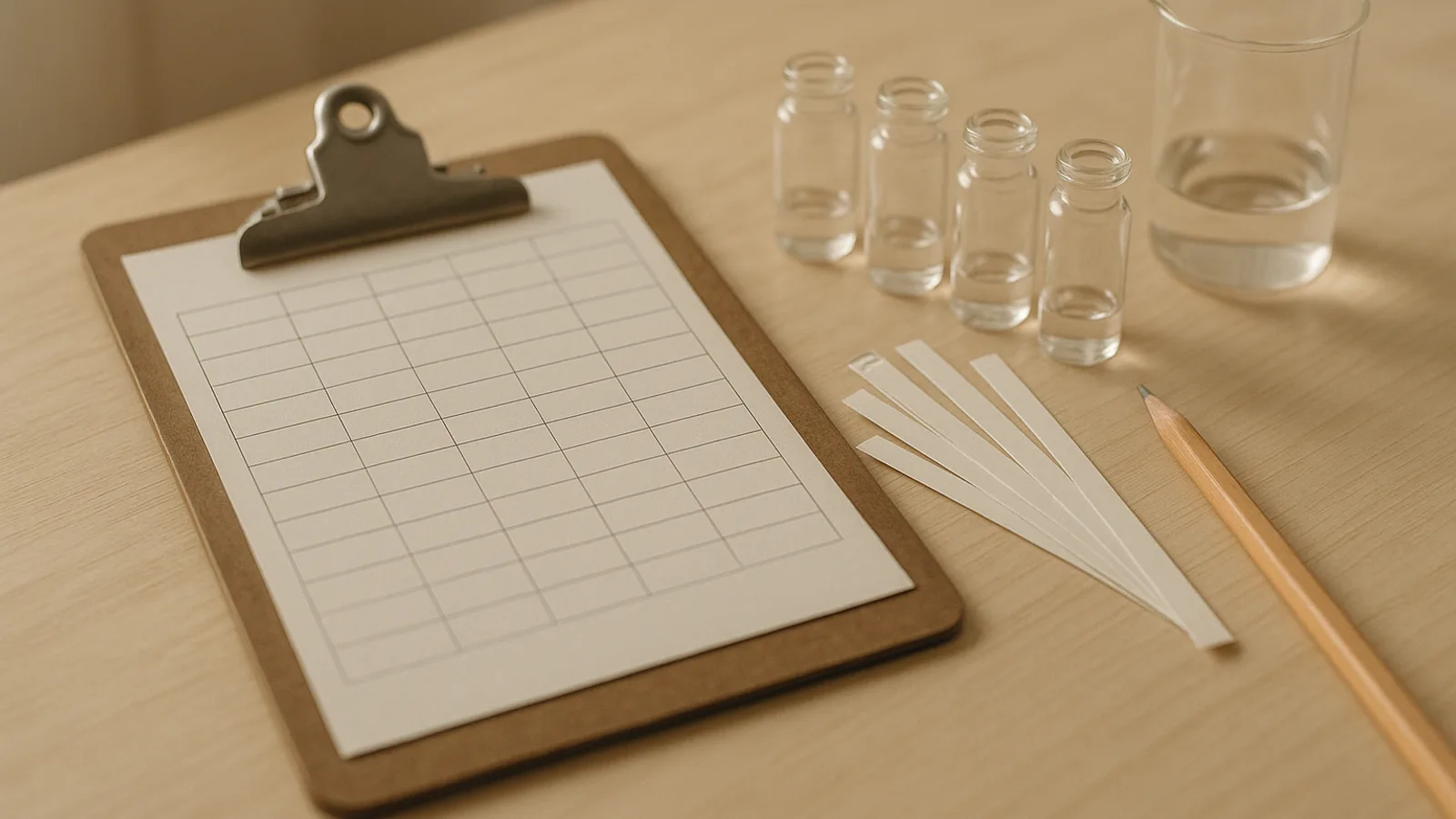
Short answer: a perfume formula sheet lists every material with its parts, its dilution and its identity (name plus CAS or grade), and it records what you actually weighed, the batch size, the concentration and the dates of maturation and maceration. Download the free printable sheet (PDF), fill in the target grams with the free calculator, and keep one sheet per batch.
Every perfumer who has made something good and could not make it again has the same story: the formula was in their head, or on a scrap of paper that said "a bit more vanillin". A formula sheet is the cheapest insurance in perfumery. It turns an afternoon of weighing into something you can repeat, adjust by one line, and compare with the version before.
What goes on a formula sheet
Professional sheets differ in layout, but they carry the same information. The header describes the batch; the body describes the materials; the footer records what happened after weighing.
| Column | What it holds | Why it matters |
|---|---|---|
| Material | The name you buy it under | Trade names differ between suppliers |
| CAS / grade | CAS number, or the supplier and grade for naturals | Bergamot from two suppliers can smell like two materials |
| Parts | The proportion, per 100 or per 1,000 | This is the formula itself |
| Dilution % | The strength of the line: neat, 10%, 1% | Parts refer to the solution, not the pure material |
| Target g | What the batch says to weigh | Worked out before you start |
| Weighed g | What actually went in | The only column that reproduces a batch |
| Notes | Substitutions, supplier lot, anything unusual | You will not remember in six weeks |
The header needs the formula name, a version number, the date, the batch size in grams and the concentration. The footer needs the maturation dates of the concentrate, the alcohol and water added, the maceration dates, and your smell notes on day one, after two weeks and after six.
How to read a formula
Three conventions trip people up.
The base. Numbers are usually parts per 100, so they read as percentages of the concentrate. Parts per 1,000 are common on professional sheets. It makes no difference as long as you divide by the total.
Dilutions in the name. "Vanillin 10%", "IBQ 10% DPG" or "Damascenone 1%" means the line is a solution. The parts are parts of that solution. Ten parts of Vanillin 10% hold one part of vanillin. You weigh the solution as written; you do not divide by ten again.
Solvents as lines. DPG, TEC or IPM sometimes appear as their own line. They are part of the concentrate as the author built it, so weigh them, but they carry no smell.
A filled-in example
This is the Brûléed Vanilla accord, a free formula on this site composed by Odette Fontaine, made as 20 g of concentrate with no alcohol. The target grams are 20 g times each line's parts divided by 100.
| # | Material | Parts | Dil. % | Target g | Pure material g |
|---|---|---|---|---|---|
| 1 | Vanillin | 25 | 10 | 5.00 | 0.50 |
| 2 | Iso E Super | 20 | 10 | 4.00 | 0.40 |
| 3 | Ultravanil | 15 | 5 | 3.00 | 0.15 |
| 4 | Tonka Bean Absolute | 10 | 10 | 2.00 | 0.20 |
| 5 | Ambrettolide | 10 | 10 | 2.00 | 0.20 |
| 6 | Ethylene Brassylate | 10 | 10 | 2.00 | 0.20 |
| 7 | Benzaldehyde | 5 | 5 | 1.00 | 0.05 |
| 8 | Azarbre | 4 | 5 | 0.80 | 0.04 |
| 9 | Birch tar rectified | 1 | 1 | 0.20 | 0.002 |
Look at the last line. Birch tar is used at 0.002 g of pure material, which no hobby scale can read. Written at 1%, it becomes 0.2 g of solution, which any 0.01 g scale weighs comfortably. That is what dilutions on a formula sheet are for.
Using the sheet for a batch
Copy the formula in
One material per row, with parts and dilution exactly as the source writes them. Give the sheet a version number.
Fill in the target grams
Choose the batch and the concentration, then calculate each line or paste them from the calculator, which also flags lines too small to weigh.
Weigh and record
Tare, add, write the actual reading in "weighed g", tare again. If you overshoot, write the real figure; a truthful sheet with 1.93 instead of 1.87 is worth more than a tidy one.
Date everything after weighing
Maturation of the concentrate, alcohol and water added, maceration start and end, chilling and filtering.
Smell and annotate
Day one, two weeks, six weeks. The next version of the formula starts from these notes.
Download
- Perfume formula sheet, English (PDF, A4 landscape)
- Scheda formula, italiano (PDF)
- Ficha de fórmula, español (PDF)
Free to print and share. It has 22 material rows, which covers most accords and many complete perfumes; print a second page for longer formulas.
Common questions
Is there a free perfume formula template?
Yes. The printable sheet on this page is free, with columns for material, CAS or grade, parts, dilution, target and weighed grams, and notes, plus fields for batch size, concentration and maceration dates.
Should a perfume formula be written in parts or percentages?
Either works, as long as the total is clear. Parts per 1,000 are handy when a formula has many trace materials, because 0.3% becomes a whole 3.
Why write the CAS number?
The same molecule is sold under several trade names, and some trade names cover different grades. The CAS number identifies a synthetic unambiguously. For naturals, write the supplier and grade instead, because origin changes the smell.
How many versions of a formula should I keep?
All of them. Change one thing between versions and write down what changed. The version that works is almost never the first, and you will want to know what you did differently.
Where to find formulas to fill it with
Eight complete accord formulas are a good first exercise, the free perfume formulas come with every dose, and the calculation guide explains every number on the sheet.