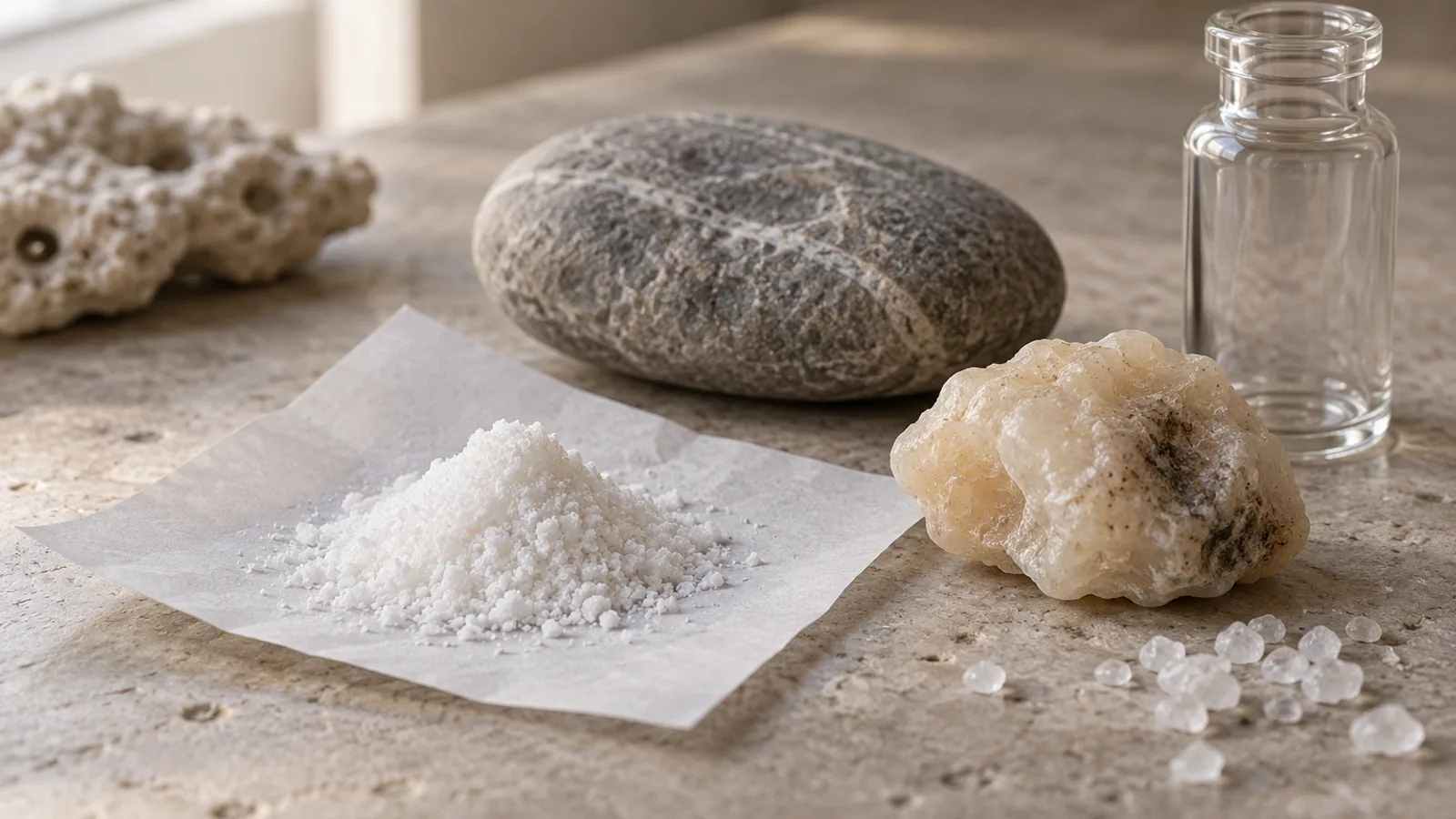
Short answer: Ambroxan is a molecule that smells of warm skin, dry wood and clean salt, the scent people describe as "expensive". It sits in 692 of the 801 famous perfumes we have reconstructed, usually at around 3%. In a few, such as Baccarat Rouge 540, Megamare and Sauvage, it reaches a fifth or more of the formula and carries the whole perfume.
Spray a modern perfume on your wrist and wait an hour. Whatever is left, that soft woody glow that seems to come from your own skin, is very often Ambroxan. Perfumers reach for it more than for almost any other material, and once you know its smell you will notice it in half the bottles at the perfume counter.
What Ambroxan smells like
On a blotter, pure Ambroxan smells dry and mineral: a sun-warmed stone, a little wood, a little salt, with a sweet edge like clean skin after the beach. It has no sugar and no flowers. It does not shout. You notice it more when you leave the room and come back.
Two things make it unusual. It lasts for days on a blotter and for many hours on skin. And a share of people barely smell it at all, a specific blind spot that some people have for this molecule. If a friend swears your perfume has disappeared while you can still smell it, Ambroxan is the likely reason.
Where it comes from
Ambroxan began as a way to copy ambergris, the waxy lump that sperm whales produce and that washes up on beaches. Fresh ambergris smells of the sea and of animals. After years of floating in salt water and sun, part of it turns into molecules with a soft, sweet, woody smell. Ambroxan is the most important of them.
Chemists first made it in 1950 from sclareol, a compound found in clary sage. Today producers make it from the same plant source or by fermentation. You will see it sold under several names: Ambroxan, Ambrox, Ambrofix, Ambroxide. They are the same molecule, sold by different makers at slightly different purities. Cetalox is a close cousin with a softer, rounder smell, and most perfumers treat it as a separate material.
How much perfumes use
We counted Ambroxan across our whole catalogue of reconstructed formulas. It appears in 692 of 801 famous perfumes, 86%, which makes it the most common aroma material we have measured. The doses vary enormously:
- As a background fixative, at well under 1%, it rounds off the base and helps the top notes last.
- At the typical dose, around 3%, you start to recognise its skin-like warmth.
- At 10% or more it becomes the main character of the perfume. The highest dose in our catalogue is above 40%.
The full figures for each material live on its page, for example Ambroxan.
Perfumes built on Ambroxan
These are the famous perfumes in our catalogue where Ambroxan is one of the three biggest materials, ordered from the heaviest dose down. In the first few it makes up around a quarter of the formula.
- Baccarat Rouge 540 Extrait de Parfum
- Baccarat Rouge 540
- Megamare
- Baraonda
- Imagination
- Valaya
- Portrait of a Lady
- Oud Minérale
- Sauvage EDP
- Sauvage Elixir
- Luna Rossa Black
- Gentle Fluidity Silver
The list covers a wide range of styles. Megamare is a marine with seaweed and salt, Portrait of a Lady a dark rose with patchouli, Sauvage a peppery fresh scent for men. Ambroxan fits all of them because it does not compete with the other notes. It sits underneath and makes everything above it last longer and feel warmer.
The complete ranking, updated with every new formula, is on Perfumes with Ambroxan. The other famous materials have the same page: perfumes by raw material.
Using Ambroxan in your own perfume
Ambroxan is a crystalline powder, so most people dissolve it first, usually as a 10% solution in alcohol or dipropylene glycol, which also makes small doses easier to weigh. Start low. At 1 to 3% it adds warmth without taking over. Push it past 10% only when you want the dry amber to be the point of the perfume.
It works best with Iso E Super and Hedione, the two other materials that sit in most modern formulas. Together they make the soft, woody, airy base that runs through a decade of best sellers. If you want to see how the three combine in a real formula, the Baccarat Rouge 540 formula is free and shows every dose.
Common questions
What does Ambroxan smell like?
Dry, warm and mineral: clean skin, sun-warmed wood and a trace of salt. It has no sweetness of its own, though it makes sweet notes feel softer.
Is Ambroxan the same as ambergris?
No. Ambergris is a natural material from sperm whales. Ambroxan is one of the molecules that gives aged ambergris its smell, made today from clary sage or by fermentation.
Is Ambroxan the same as Ambrox and Ambrofix?
Yes, they are trade names for the same molecule from different producers. Cetalox is related but smells different.
Why can't I smell Ambroxan?
Some people have a specific blind spot for it. They smell the rest of the perfume but very little of the Ambroxan, while people around them notice it clearly.