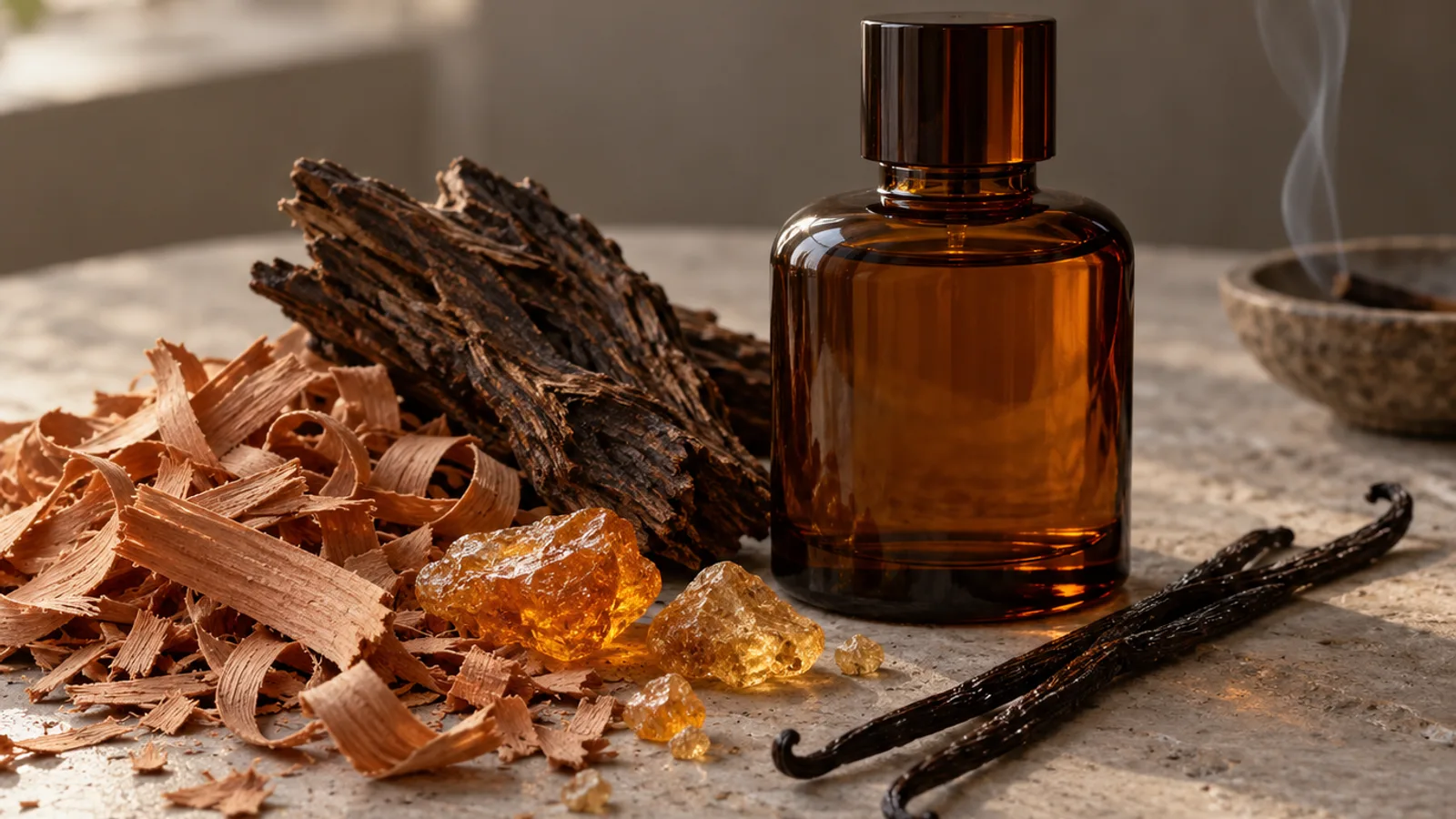
Short answer: a woody oriental perfume pairs dry woods, such as cedar, sandalwood or oud, with something warm and sweet: amber, vanilla, resins or spice. Today most classifications call the family "amber woody". Across the 61 formulas of this family in our catalogue, the materials that recur most are Iso E Super, Ambroxan, vanillin and Cedramber. Oud Wood, Bal d'Afrique and Noir Extrême are three well-known examples.
Think of a wooden cabin with a fire going, a cup of something sweet on the table and a jumper that smells of smoke. That is the mood of most woody oriental perfumes. They are the scents people reach for in October, and the ones that get compliments in a closed room in January.
Woody, oriental, amber: the names
Perfumers sort fragrances into families by their main character. "Woody" means the base is built on woods. "Oriental" was the old name for warm, sweet, resinous perfumes with vanilla, amber and spice. A woody oriental sits between the two: wood gives it structure, the warm side gives it softness.
The industry has been moving away from the word "oriental" for a few years, and most reference guides now say "amber" instead. You will see the same perfumes listed as woody oriental, woody amber or amber woody. They mean the same family. On our site it is Amber Woody.
The materials they share
We looked at every formula in the family and counted which materials come up again and again. Out of 61 formulas:
| Material | In how many | What it brings |
|---|---|---|
| Iso E Super | 50 | Velvety, cedar-like wood that seems to glow. |
| Ambroxan | 48 | Dry, skin-like amber. |
| Vanillin | 46 | The sweetness, at low doses. |
| Cedramber | 43 | Dry cedar with an amber edge. |
| Hedione and Hedione HC | 39 and 42 | Air and lift, so the woods do not feel heavy. |
| Exaltolide and other musks | 41 | Softness and a clean skin feel. |
| Coumarin | 35 | Hay and tonka bean. |
| Patchouli | 33 | Earthy, dark depth. |
| Cashmeran | 30 | Soft, dusty, cashmere-like warmth. |
Look at the top of the list. Iso E Super and Ambroxan appear in four out of five of these perfumes, and both are synthetic. Most modern woody orientals get their woods from molecules, with a little cedar or patchouli oil on top for texture. Real sandalwood and real oud are rare and expensive, so they usually appear as small touches or as reconstructions.
Famous woody oriental perfumes
These are some of the best-known perfumes in the family, all with full formulas in our catalogue:
- Oud Wood: smooth woods and a soft oud, with cardamom and vanilla.
- Oud Satin Mood: oud and rose wrapped in vanilla.
- Interlude Man: smoky incense and resins, very loud.
- Alien: jasmine over a dense amber and wood base.
- Coco Noir: dark, elegant, with patchouli and tonka.
- Bal d'Afrique: bright citrus and flowers over vetiver and cedar.
- Tobacco Mandarin: tobacco, leather and labdanum.
- Noir Extrême: cardamom, nutmeg and a creamy, almost edible base.
- Another 13: the minimalist end of the family, almost all musk and amber.
- Santal Blush: creamy sandalwood with spice.
You can see how wide the family is. Interlude Man and Another 13 sit at opposite ends, one dense and smoky, the other almost transparent, but both rest on the same idea: wood plus warmth.
A simple structure to build your own
This is a starting sketch for learning, not the formula of any perfume. The numbers are parts out of 100 of concentrate.
Start with the wood: 40 to 50 parts
Iso E Super does most of the work. Add some Cedramber or cedarwood oil for dryness, and a sandalwood material such as Javanol or Sandalore if you want creaminess.
Add the warmth: 15 to 25 parts
Ambroxan for amber, Cashmeran for softness, a few parts of patchouli for depth. This is where the "oriental" side lives.
Sweeten with care: 3 to 8 parts
Vanillin and coumarin. Keep them low. A woody oriental should feel warm, and too much vanilla turns it into a gourmand.
Soften and lift: 15 to 25 parts
Musks such as Exaltolide or Habanolide for a skin feel, Hedione for air. Without this part the woods sit heavy and flat.
Choose one accent: up to 10 parts
Cardamom, pink pepper, incense, tobacco or a little rose. One clear accent gives the perfume a face. Five accents make it muddy.
Make a small test batch, 5 or 10 g, and leave it for two weeks before you judge it. Woody materials open up slowly. If you want to skip the trial and error, start from a real formula from the family and adjust it: our formula calculator rescales any formula to the bottle size you want.
Common questions
What is a woody oriental perfume?
A perfume built on woods, such as cedar, sandalwood or oud, combined with warm, sweet materials like amber, vanilla and resins. Most guides now call the family amber woody.
What is the difference between woody and woody oriental?
A plain woody perfume stays dry and green, like cedar or vetiver. A woody oriental adds sweetness and warmth from amber, vanilla or resins.
Is oud a woody oriental?
Most oud perfumes are, because oud is usually paired with rose, amber or vanilla. Oud Wood and Oud Satin Mood are two examples.
Are woody oriental perfumes good for summer?
They feel best in autumn and winter. In summer, choose the lighter end of the family, such as Bal d'Afrique or Another 13, and wear less.